PRIMI Project
Project title: Piloting Research and Innovation at Maritsa Iztok using waste clay extracted during lignite mining for traditional and alternative construction materials (PRIMI)
Project number: 101193556 — PRIMI
Project proposal under the call: [RFCS-2024-JT-Big tickets for Coal
(RFCS-2024-JT)]
Fund providing the co-financing: RFCS
(Research Fund for Coal and Steel) at EC
Administrator of funds: European Research Executive Agency (REA) – via the Grant Agreement – effective since 24.06.2025
Total Project budget: 6,516,660.60 €
Co-financing from the Grant: 50%
Project duration: 48 months
General information
Maritsa Iztok Complex in Bulgaria, a vital industrial hub known for its lignite mining and coal-fired power plants, faces significant challenges. Plans for coal phase-out by 2038 and decrease in coal production in the recent years are raising concerns among employees and making it necessary to look for new prospects for the company. Structural changes in the energy market and the introduction of liberalisation under the new Energy Act are further intensifying these challenges, accelerating the need for alternative path for the company's development. Moreover, compliance with the environmental regulations of the European Union (EU) creates further obstacles, alongside the need to maintain energy production and industry competitiveness.
To address these challenges, a collaborative effort among stakeholders is essential. The Just Transition Fund offers vital support for this transition, with a focus on investing in renewable energy, energy efficiency, job support, training, and reskilling for renewable energy sectors. The repurposing of coal mine lands, effective utilization of natural resources and attracting new investments are crucial aspects of this transition, offering opportunities for reskilling and entrepreneurship among affected workers.
Accelerating the adoption of new products and practices, along with technology transfer through R&I projects, supports the transition to a circular economy. Embracing sustainable practices and resource diversification, initiatives such as the pilot project undertaken by MMI to utilise waste clays for construction materials, contribute to resource optimisation and the creation of alternative jobs, particularly for the younger generation in the region.
PRIMI
PRIMI is a pilot project aiming at proving the application of clay extracted during lignite mining in "Mini Maritsa Iztok" EAD, Bulgaria, as a raw material in traditional and alternative construction materials.
Essentially, it is a good example of circular economy, innovation, obtaining of new materials with significantly reduced CO2 emissions, support for local communities through the creation of new jobs, etc.
After study and characterization of waste clays and raw materials suitable for work on the project, the research will mainly be related to the synthesis of the following materials:
- Ceramic materials (low firing bricks and clinker bricks with improved mechanical properties).
- New ceramic foam materials and composites with improved heat and sound insulation properties.
- New geopolymer materials and composites based on them.
In order to reach this final stage of the project, it is necessary to fully characterize the waste clays from the excavations of Mini Maritsa-Iztok EAD (Fig. 1), as well as the additional raw materials. Then, at the laboratory level, several suitable compositions and modes for their production must be selected and optimized. The samples obtained will be further studied to clarify the relationships between composition and structure, heat treatment mode, degree of sintering or foaming, and others.
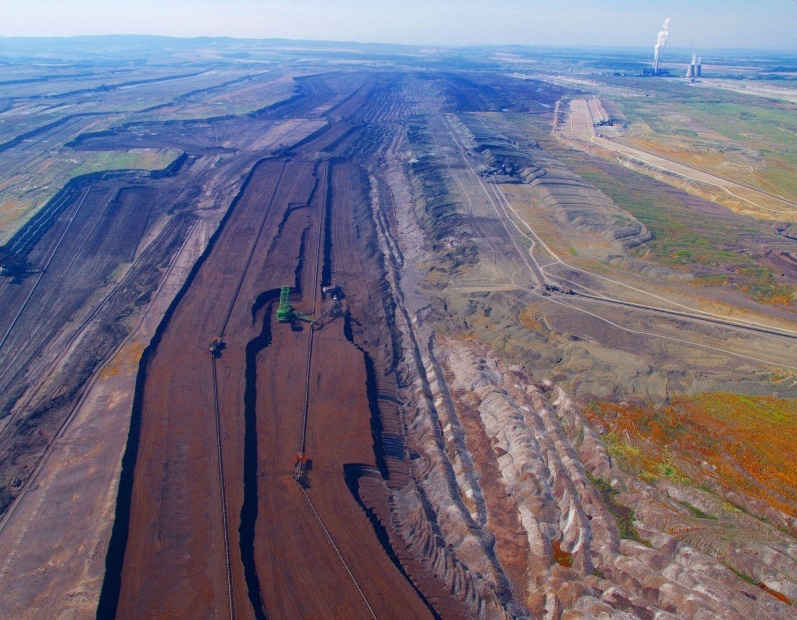
Lignite coal is currently the main source of energy in Bulgaria. In order to extract it, "Mini Maritsa-Iztok" EAD annually excavates, transports and backfills huge earth masses (overburden) - from 65 to 80 million m3 per year on average - before the heavy mining machines get down to the lignite deposit (Fig. 2). After the lignite is extracted, these volumes of earth mass are moved back to fill the space over the deposit.
The overburden consists of a layer of soil and different types of clays, which are also seen as a suitable basic raw material for both traditional ceramics used in construction and the alternative geopolymer materials developed in the last decade.
As in open-cast mines clay is the waste from the mining activity, its utilization actually closes the circular economy loop.
Project impact
Alignment with EU Priorities:
The successful implementation of the project will provide some crucial aspects of transition from coal to cleaner technologies:
- repurposing of coal mine lands;
- effective utilization of natural resources and waste;
- attracting new investments;
- enable technology transfer from research projects to practice;
- accelerate the deployment of new products with improved properties and significantly reduced amount of carbon emissions released during their production;
- support the transition to a circular economy: Embracing sustainable practices and resource diversification, initiatives such as the pilot project undertaken by MMI to utilise waste clays for construction materials, contribute to resource optimisation and circular economy in practice.
Socio-Economic Impact: The successful implementation of the project and especially obtaining the results that are expected, will have a significant role in creation of new jobs, especially in the PRIMI+ period when production of new construction materials will be scaled up from pilot plants to a factory.
Expected key socio-economic impacts of the project are:
- support for local communities through investments in energy efficiency;
- support for jobs, offering opportunities for retraining and entrepreneurship among affected workers;
- provide alternative pathways for employees, management, and partners.
In terms of industry, we believe, that the innovative construction materials will attract new investments and the interest of construction companies that are open to greener materials and technologies.

